
Platform AI now makes more than 80% of ad-auction decisions. Without your first-party data flowing in, those systems optimize blind — chasing clicks instead of customers.
For omnichannel retailers, that blindness has a specific shape. The auction sees your website. It does not see your stores. So it optimizes toward the slice of demand that happens to convert online, and treats every store trip your media created as if it never happened.
That is not a measurement problem you can report your way out of. It is an optimization problem. The model bids on what it can see.
Most retail sales still happen in physical stores. E-commerce accounted for 17.1% of total US retail sales in the second quarter of 2026 — $340.2 billion out of $1,986.5 billion, seasonally adjusted, per the US Census Bureau. Roughly $83 of every $100 Americans spend at retail still crosses a physical counter. For a retailer with a real store footprint, the majority of the revenue your ads produce is invisible to the systems deciding where your budget goes.
The consequences compound:
Most omni retailers have already tried the obvious fix: upload in-store transactions as offline conversions. It helps with reporting. It does much less for optimization — and the reason is structural, not operational.
Walled gardens are built for digital journeys. Their models learn from sequences: an impression, a click, a product view, a cart add, a purchase. That sequence is the unit of learning. The ranking systems are not really trained to recognize buyers — they are trained to recognize the shape of a journey and identify who is early on one.
An in-store transaction arrives without a journey. Uploaded on its own, it tells the platform that someone bought. It says nothing about the browsing, comparison, and intent that led there — precisely the context the model needs in order to go find the next customer like them. The event can be credited in reporting, but it has almost nothing to teach the auction.
That mismatch is the root cause. Two familiar symptoms follow from it:
Fixing latency and match rates makes an offline upload a better record. It does not make it a better signal. What the platform is missing is the online journey that preceded the store visit.
The fix is not more uploads. It is a signal layer that turns store demand into something the auction can act on in the first place.
There is a second structural mismatch, and it compounds the first.
Online research to online purchase runs on a short clock. Online research to store purchase runs on the customer's errand cycle — the weekend, the restock, the trip they were already going to make. Days pass. Often weeks.
Attribution windows were built for the shorter clock. Meta tops out at a seven-day click window; Google requires offline conversions be loaded within 7 days for data-driven attribution to work. A meaningful share of the store purchases your media actually caused land after the window has already closed.
Two things break, and only one of them is a reporting problem.
Uploading the purchase later doesn't solve this. A late event is still a late event.
The answer is to stop waiting for the outcome and predict it instead. An in-store propensity score is computed at the moment of the online session — inside the window, while the impression is still attributable. The platform receives a valued, in-window event that stands in for an out-of-window outcome.
Measurement follows the same logic. Window-bound attribution will always understate omni performance, so the honest read comes from incrementality — conversion lift studies and geo or matched-market tests, which measure the effect without depending on an attribution window at all.
All of this assumes store demand is knowable from online behavior in the first place. It is — and not subtly.
Across one apparel retailer's 576,267 labeled households, the average household bought in store 1.87% of the time. Layering online behaviors multiplies that rate sharply.
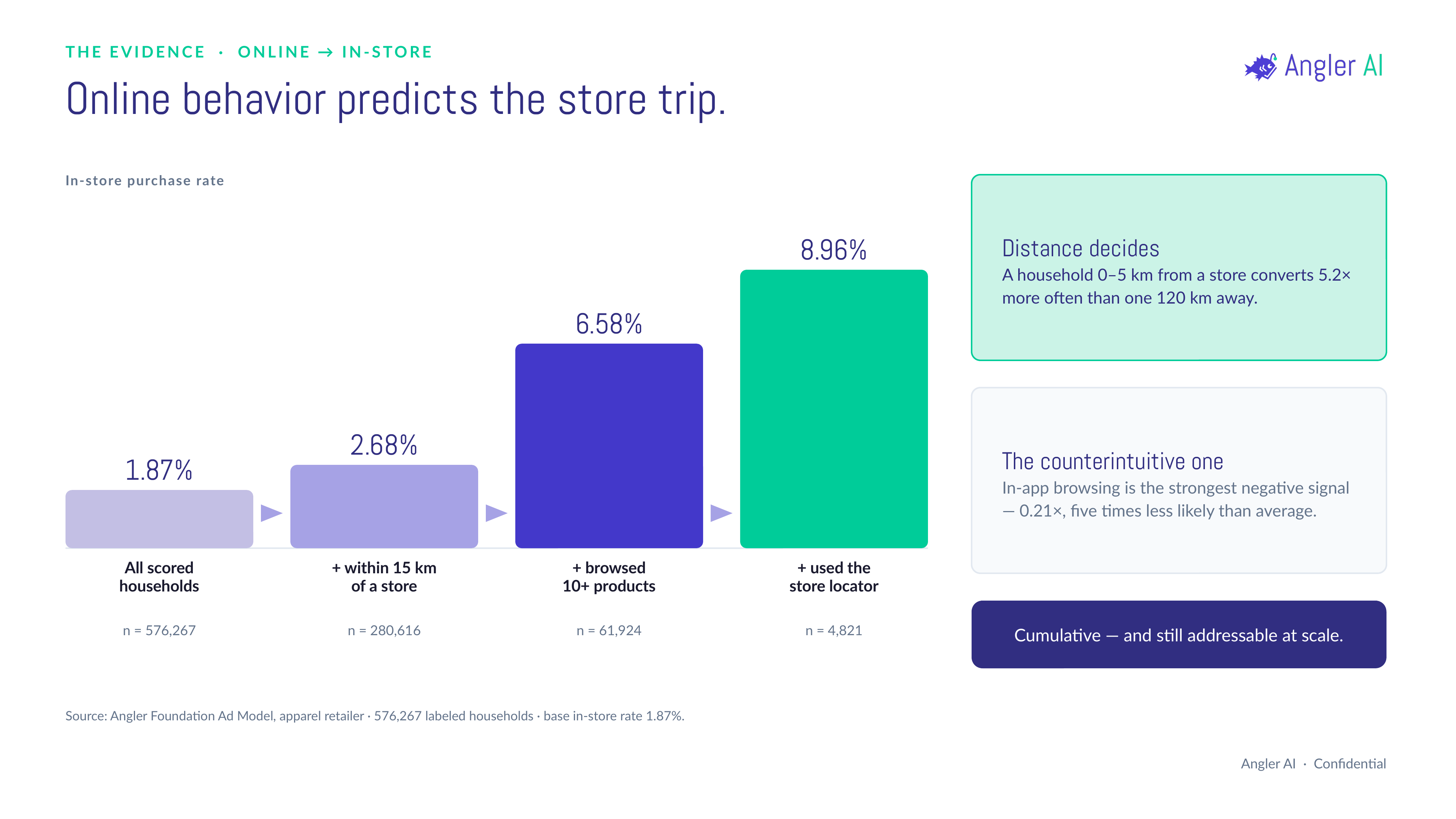
Two findings are worth pulling out. Proximity dominates: a household 0–5 km from a store converts 5.2× more often than one 120 km away, which is why a store directory file turns out to matter as much as behavioral data. And in-app browsing is the strongest negative signal at 0.21× — five times less likely than average to end in a store visit, because in-app traffic is largely social-referred, arrives through shared mobile gateways, and often sits far outside any trade area. That one is counterintuitive enough that no rules-based audience would ever find it.
Patterns like these are exactly what a model is for — not because any single one is decisive, but because they compound across thousands of households simultaneously.
Scored and ranked, the concentration is severe: the top 10% of the audience contains 51% of everyone who goes on to buy in store, and the top 5% contains 33%. Spread spend evenly and those same slices return 10% and 5%. The best-scoring visitors buy in store 6.6× more often than an average one — a 12.2% in-store rate against a 1.86% base.
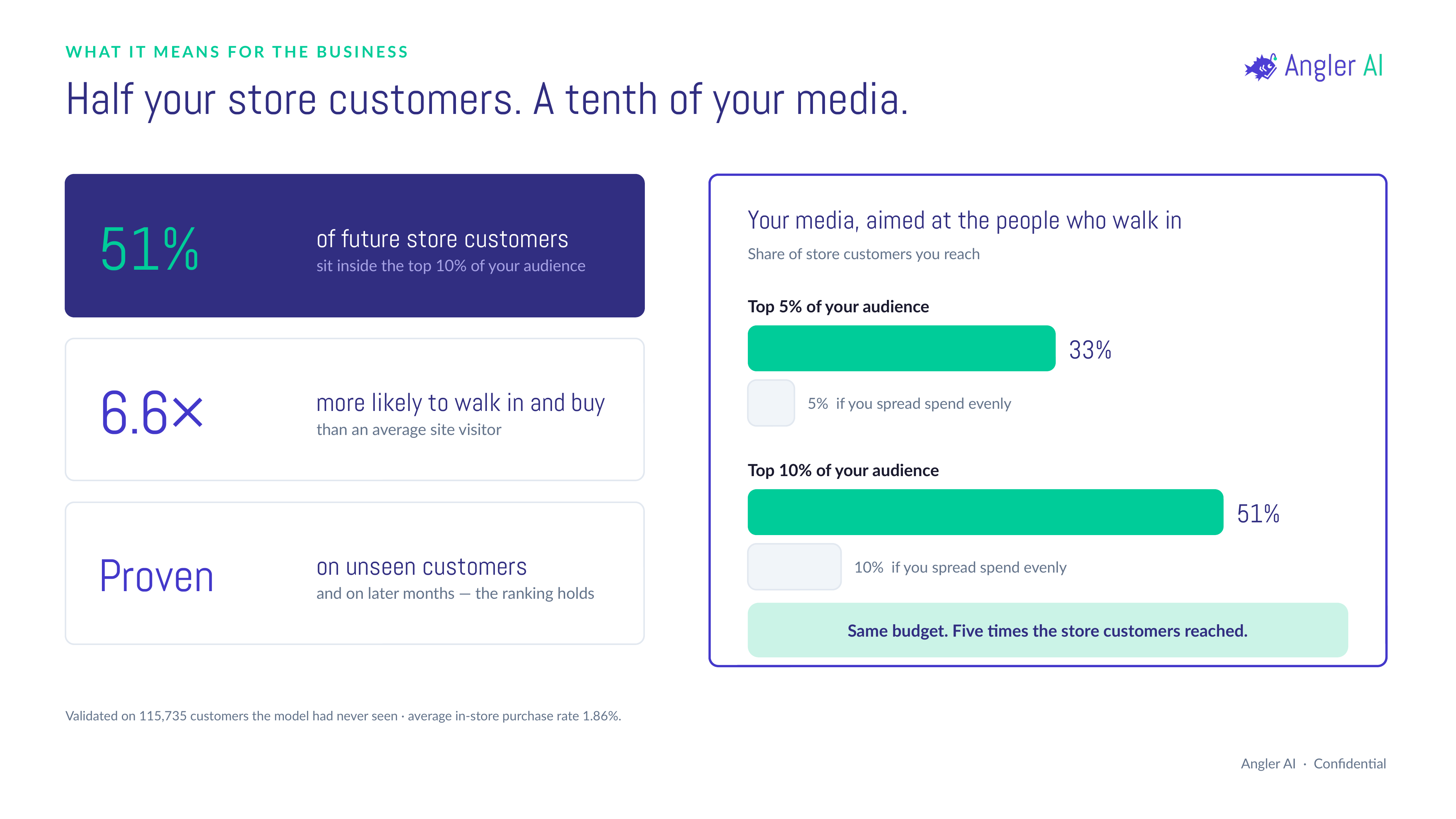
It also holds up where it counts: validated on 115,735 households the model never trained on (holdout AUC 0.848), and on a later month it had never seen (0.86). A model that only fits its training window is not something you can put a budget behind.
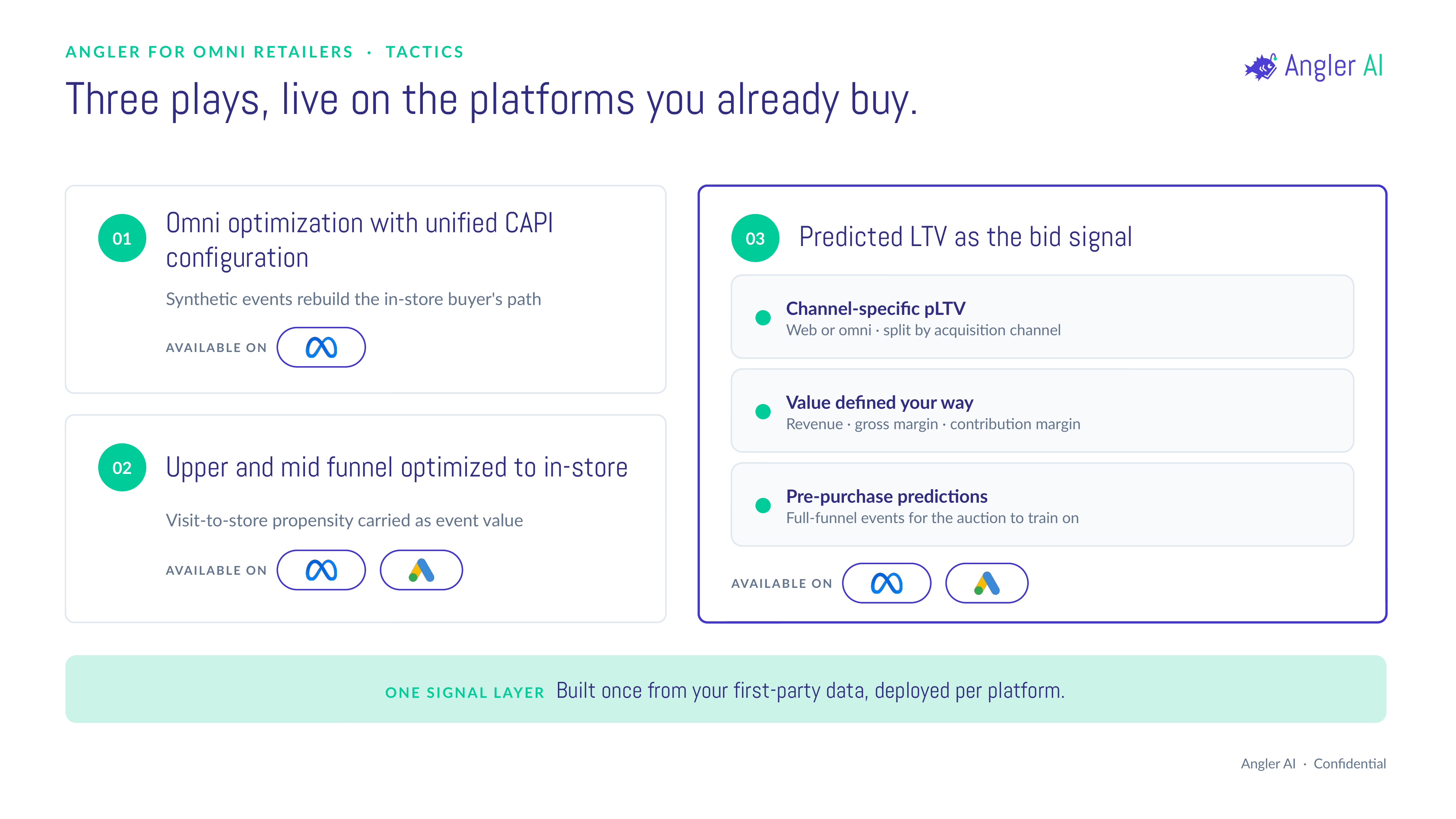
Instead of running a web pixel and a separate offline upload, one Predictive CAPI configuration carries both online and in-store events into the platform under a single, deduplicated event structure.
The differentiator is what happens to store buyers. Once incremental order files start landing — hourly, or daily at minimum, with in-store orders identified by source type — Angler builds synthetic upper- and mid-funnel events for those buyers, reconstructing the digital path that preceded the store trip: page viewed, product viewed, add to cart, checkout signals. The auction sees a complete funnel for a customer who bought offline, not an orphaned conversion. Hourly delivery also keeps those events inside platform freshness limits, rather than arriving as a stale batch the auction can no longer act on.
Available on: Meta.
Prospecting campaigns need an objective that correlates with store revenue. Angler's Foundation Ad Model scores each online visit for propensity to convert in store, and that score is sent as the value on upper- and mid-funnel events.
The effect is direct: value-optimized prospecting and mid-funnel campaigns start bidding toward visits that lead to store purchases, rather than toward the online-conversion proxy that has been standing in for them.
This is also what defuses the lag problem. The score fires during the session, so the signal reaches the auction inside the attribution window even though the purchase it anticipates may be two weeks away in a store aisle.
Available on: Meta, Google Ads.
Once store demand is visible, the next question is what a conversion is worth. Predicted LTV replaces flat conversion counting as the value the auction optimizes against.
Channel-specific pLTV. Predicted LTV can be scoped to web only or to omni — online plus in-store — and split by acquisition channel, so an “acquired online” customer carries a different forward value than one acquired in store.
Flexible value definition. Value can be defined as revenue, gross margin, or contribution margin. Margin-based bidding matters most in retail categories where basket composition varies widely.
Pre-purchase predictions. Because the model scores prospects before they buy, the auction gets full-funnel events to train on instead of only sparse purchase events. More training signal, earlier in the journey.
Available on: Meta, Google Ads.
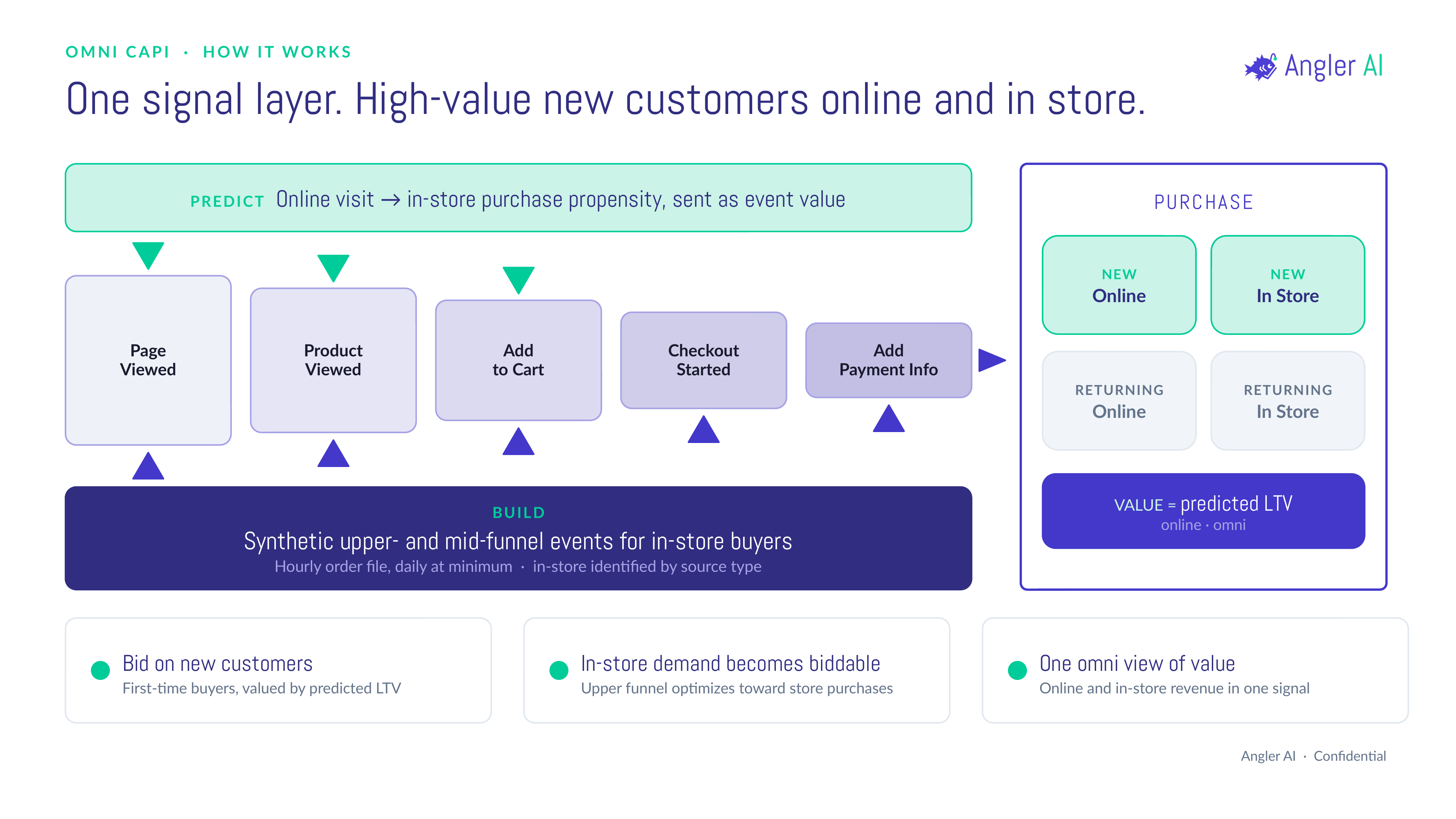
Two flows sit around the same funnel. Above it, the in-store propensity prediction supplies value to upper- and mid-funnel events. Below it, synthetic events reconstruct that funnel for customers who finished in a store. At the end, purchases are classified on two axes — new versus returning, online versus in-store — and valued with predicted LTV.
One signal layer, built once from your first-party data, deployed per platform.
The requirements are less demanding than most retailers expect:
Angler has run 600+ A/B tests across brands and verticals, and typically reaches a first measurable result within four weeks.
It is the practice of feeding both online and in-store conversion signals into ad platforms so their AI bids toward total revenue rather than the online-only slice it can natively observe.
Through a server-side Conversions API integration. Angler's Predictive CAPI carries in-store orders — identified by source type in an hourly order file, daily at minimum — alongside web events in a single configuration, and adds synthetic upper- and mid-funnel events so the auction sees a complete path.
Reconstructed upper- and mid-funnel events for customers who purchased in store, built from first-party data. Ad platforms learn from digital journeys, so an isolated offline purchase teaches them little; synthetic events restore the online path that preceded the store visit, giving the model the sequence it is designed to learn from.
Yes. A model scores each visit for in-store purchase propensity, and that score is passed as event value, letting value-optimized prospecting bid toward store outcomes. This works on Meta and Google Ads.
Yes, and with meaningful separation. Behaviors like store-locator use, product-browsing depth, and proximity to a store compound into large differences in in-store purchase rate — from a 1.87% base to 8.96% for the highest-intent tier in one retail deployment. Scored and ranked, the top 10% of an audience can contain around half of all future in-store buyers.
Purchase value optimizes for the size of today's basket. Predicted LTV optimizes for the forward value of the customer, which is what separates a high-value new customer from a one-time discount buyer. Angler customers see 54–84% lower new-customer CAC.
Your stores are producing revenue your media never gets credit for — and, more importantly, never gets optimized toward. The gap closes when the auction can see the whole customer.